
Alchemy is the art of transformation. It is an ancient tradition focused on the deepest processes of change, matter, consciousness, and energy. Not simply primitive chemistry, it is a philosophy of nature and existence. Its roots lie in ancient Egypt and the Middle East, intertwined with mythology, cosmology, and medical systems passed down over millennia.
One of the most influential sources in Western alchemy is the Emerald Tablet, attributed to Hermes Trismegistus. This is a legendary figure often seen as a blend of the Egyptian god of wisdom Thoth and the Greek Hermes. While the text survives only in medieval Arabic manuscripts, during the Renaissance it was regarded as a concise summary of Hermetic philosophy, describing the laws of nature and transformation.
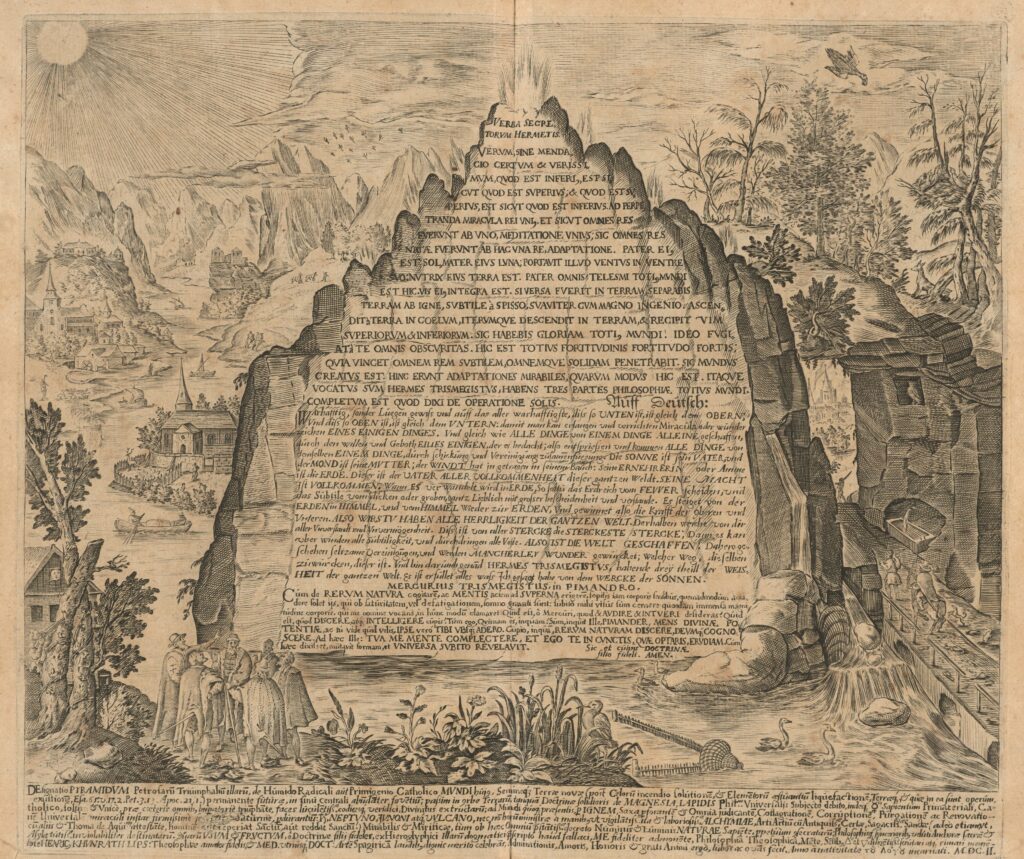
The most famous Hermetic principle from the Emerald Tablet states:
“What is above is like what is below.”
This rule emphasizes the deep correspondence between the structure of the universe and the structure of the individual, forming the philosophical foundation for later alchemical and spagyric systems.
In the 16th century, Swiss physician and alchemist Paracelsus (1493–1541) brought alchemy closer to medicine and human health. He introduced a practical model to understand nature and disease, based on three fundamental principles (the Tria Prima): Sulphur, Mercury, and Salt.
For Paracelsus, these were not ordinary chemical substances but philosophical principles expressing the essence of matter and consciousness:
Paracelsus used this model not only to explain material phenomena but also to develop medical insights. He saw disease as a disturbance in the balance between these three principles and healing as the restoration of harmony.
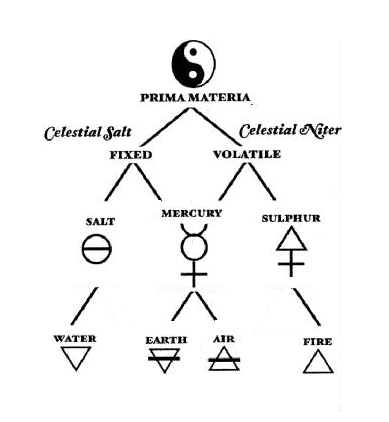
The word spagyrics comes from Greek: spao meaning “to separate” and ageiro meaning “to reunite.” It describes exactly what Paracelsus and his followers sought to achieve: by separating and purifying the components of a substance and then bringing them back together, a more soulful and effective medicine is created.
While classical alchemy focused on the Magnum Opus, turning base metals into gold and seeking the legendary Philosopher’s Stone, spagyrics applies the same principles practically in healing and natural preparations.
In the spagyric method, the three principles are first separated, purified, and then reunited to reveal and make accessible the hidden qualities of a plant, mineral, or crystal. This process reflects the classical Hermetic law that all natural principles form a single whole and that understanding this unity is the goal of true transformation.
The Tria Prima express a dynamic relationship that alchemists used to describe both natural processes and inner transformation. Sulphur’s fiery quality works with Mercury’s flowing movement and Salt’s ordered structure, together forming the building blocks of both material and subtle reality.
In this context, alchemy is not only a physical practice in a laboratory but also a philosophical and spiritual framework exploring the relationship between body, soul, and spirit. Alchemy and spagyrics offer a deep view of transformation and not only in material terms but as a way to understand the hidden qualities of nature and humanity.
The Emerald Tablet lays the foundation, Paracelsus’ Tria Prima gives structure, and spagyrics brings it all into practical application through preparations that reveal and integrate the essence of matter.
